
Container Loading Calculator - CBM, Weight & Space Utilization
Enter carton dimensions, weight, and quantity to compare 20ft / 40ft / High Cube / Reefer container options and choose the right equipment without overpaying for unused cargo space
Not Sure Whether to Book a 20ft or 40ft Container? Calculate the Load Online
Check CBM, total cargo weight, and fill rate to confirm that your shipment fits and avoid paying for empty space
Who Is This Tool For?
This tool is built for companies shipping FCL (Full Container Load) that need to understand whether a 20ft or 40ft container is the better commercial choice.
- Importers and procurement teams — to make sure the shipment fits and avoid paying for a second container because of “just a few extra cartons.”
- Marketplace sellers and distributors — to factor CBM and weight into landed cost and logistics planning.
- Logistics teams and freight coordinators — to compare 20ft / 40ft / 40ft HC options and see the projected fill rate.
- Suppliers and warehouse teams — to receive clear shipping data, including container type and packaging constraints.
How Does the Container Selection Work?
A simple workflow: enter the shipment data and get a side-by-side comparison of container options.
- Enter cargo parameters: L × W × H, weight, and number of cartons or pallets.
- The calculator estimates total CBM, total shipment weight, and fill percentage.
- It compares 20ft Standard / 40ft Standard / 40ft High Cube / other supported formats and suggests a more rational container type.
- It checks basic internal dimension and door constraints and generates an approximate loading layout for identical cartons.
If your shipment is non-standard or includes mixed carton sizes, submit a request for a manual loading layout calculation.
CONTAINER LOADING CALCULATOR 4.5 EN
CONTAINER TYPE:
PACKAGE DIMENSIONS:
Length, cm
Width, cm
Height, cm
PACKAGE WEIGHT:
Weight, kg
QUANTITY:
Quantity, pcs
Please fill in all fields!
RESULT
Container capacity0 pcs
Container volume0 m³
Max payload0 kg
Your quantity0 pcs
Does it fit?--
Total cargo volume0 m³
Total cargo weight0 kg
LOADING PLAN (TOP VIEW)
* 1st tier floor layout
LOADING PLAN (SIDE VIEW)
* Projection by length and height
The calculation is conditional and for informational purposes only. Precise calculations and loading plans will be provided by the project manager.
Need a Precise Logistics Calculation?
Leave your contact details and our team will prepare a more accurate loading and routing assessment for your shipment
Container Dimensions and Volume: Internal Size (L × W × H) and CBM
Values are approximate and may vary by shipping line and manufacturer. Use them for preliminary container selection.
| Container Type | Code | Internal Length, m | Internal Width, m | Internal Height, m | Volume, m³ (CBM) | When to Choose |
|---|---|---|---|---|---|---|
| 20ft Standard | 20DC | 5.898 | 2.352 | 2.393 | 33.2 | Basic option for small batches |
| 20ft High Cube | 20HC | 5.898 | 2.352 | 2.698 | 37.4 | When height and extra volume matter |
| 40ft Standard | 40DC | 12.032 | 2.352 | 2.393 | 67.7 | Universal choice for large batches |
| 40ft High Cube | 40HC | 12.032 | 2.352 | 2.698 | 76.3 | More volume thanks to height |
| 40ft High Cube Wide | 40HCPW | 12.100 | 2.426 | 2.694 | 79.1 | When width and dense packing matter |
| 45ft Container | 45DC | 13.556 | 2.352 | 2.393 | 76.2 | Maximum length with standard height |
| 45ft High Cube | 45HC | 13.556 | 2.352 | 2.698 | 86.0 | For very large batches (max CBM) |
| 20ft Reefer | 20RF | 5.444 | 2.290 | 2.276 | 28.3 | Temperature-controlled cargo, less internal volume |
| 40ft Reefer | 40RF | 11.583 | 2.290 | 2.250 | 59.6 | Temperature-controlled cargo, large batches |
| 45ft High Cube Reefer | 45HCRF | 13.102 | 2.294 | 2.509 | 75.4 | Temperature-controlled cargo + high volume |
Calculator Limitations
Important: the calculator estimates loading by carton dimensions, but real container utilization depends on packaging configuration.
The tool helps you make a quick decision, but final accuracy depends on the shipment setup:
- Palletization: pallets reduce usable space and change the loading layout.
- Crating, protection, and dunnage: these add both dimensions and weight.
- Mixed carton sizes: ideal packing becomes less efficient.
- Center of gravity and cargo securing: some shipments cannot be loaded “like cubes.”
- Payload limits: the cargo may fit by volume but exceed permissible weight.
If the shipment is high-value or operationally complex, it is better to prepare an accurate routing and loading calculation before paying the supplier

Examples of Container Loading Calculations
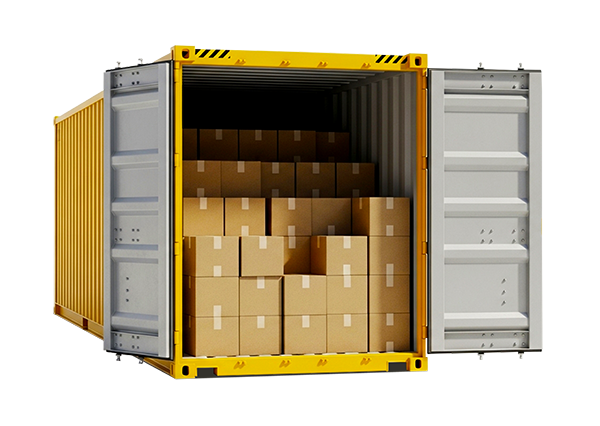
Example 1 (cartons 60 × 40 × 30 cm, 800 pcs, 12 kg each)
Shipment volume: 0.6 × 0.4 × 0.3 × 800 = 57.6 m³
— Does not fit into a 20ft container by volume
— Fits into a 40ft container (estimated fill rate: ~99%)
— A 40ft HC provides more free space (estimated fill rate: ~85%)
— Does not fit into a 20ft container by volume
— Fits into a 40ft container (estimated fill rate: ~99%)
— A 40ft HC provides more free space (estimated fill rate: ~85%)
Example 2 (cartons 50 × 40 × 35 cm, 400 pcs, 10 kg each)
Shipment volume: 0.5 × 0.4 × 0.35 × 400 = 28.0 m³
— A 20DC container would be loaded to approximately 98.5% based on the loading layout, with capacity left for about 6 additional cartons
— A 20DC container would be loaded to approximately 98.5% based on the loading layout, with capacity left for about 6 additional cartons
Example 3 (EUR pallets 120 × 80 cm, height 160 cm, 18 pcs, 210 kg per pallet)
Shipment volume: 1.2 × 0.8 × 1.6 × 18 = 27.65 m³
— A 40DC container fits this load based on the loading layout, with room left for around 7 similar pallets
— Some empty space remains along the sides and in vertical height
— A 40DC container fits this load based on the loading layout, with room left for around 7 similar pallets
— Some empty space remains along the sides and in vertical height
Always account for the actual loading layout by carton or pallet dimensions. The nominal container CBM and the real cargo fit are not the same.

Houston, We Have a Problem
You probably have questions that you didn’t find answers to here. But the answers do exist.
Visit our FAQ section, where everything is based on real cases.
💡 Useful services
You may also be interested in



Answers to Frequently Asked Questions
What is CBM and why does it matter?
How do I choose between a 20ft and a 40ft container?
When do I need a High Cube (HC) container?
What is the benefit of a Pallet Wide container (40ft HC PW)?
Why does a reefer container have less usable volume?
If the shipment fits by volume, is that enough?
Can I calculate palletized cargo?
How accurate is the loading layout?
What should I consider if the cargo will be crated or protected?
What data should I send to a supplier in China to avoid container selection errors?
Container Loading Calculator for FCL: Volume, Weight, and Container Type Selection
The Container Loading Calculator helps you quickly assess whether a shipment fits into a selected container type and identifies where potential losses occur: through excess volume, incorrect stacking height, or weight overloads. Enter the packaging dimensions (L×W×H), weight per box, and the number of units — the system will calculate the total volume (CBM), total shipment weight, and space utilization percentage. This is a critical planning stage for any business utilizing sea freight from China.
For efficient FCL (Full Container Load) supply chain planning, it is essential to compare not only standard 20-foot and 40-foot containers but also specialized options: High Cube (HC), Wide, and Reefer (RF) units. High Cube containers are chosen when internal height is critical (for boxes, pallets, or wooden crating). Wide models are ideal for maximizing floor width utilization. Reefer containers (RF) are indispensable for temperature-sensitive cargo; however, they have significantly less usable volume due to wall thickness and the cooling unit — this must be factored into the preliminary CBM calculation.
Why is Accurate Load Planning Essential for Shipping from China?
Logistics cost optimization directly depends on how effectively you utilize paid freight space. In FCL shipping, you pay for the entire container regardless of whether it is 50% or 95% full. Utilizing an online loading calculator prevents "shipping air," where excessive empty space remains in the container, thereby increasing the unit cost of every item.
Key advantages of preliminary load modeling:
- Reduced Logistics Costs: You can adjust the order volume to fill the container to its maximum capacity.
- Overweight Control: The calculator considers both volume and total weight, helping you avoid port fines and customs clearance issues.
- Selecting Optimal Packaging: By understanding container dimensions, you can instruct your factory in China to modify master box sizes for perfect stacking.
Comparing Popular Container Types: 20ft vs 40ft vs 40ft HC
The choice of equipment depends on the specifics of your cargo. A 20-foot container (20' GP) is often used for heavy, compact goods such as metal, tiles, or industrial machinery. Its usable volume is approximately 33 cubic meters, but in practice, about 28-30 m³ is actually loaded.
The 40-foot standard container (40' GP) and its taller counterpart, the High Cube (40' HC), are the preferred choices for consumer goods. If your product is lightweight and bulky, the 40' HC provides an additional 30 cm of height, allowing for an extra row of boxes and significantly improving the shipment's unit economics. During calculation, remember that actual capacity is usually 10-15% less than the theoretical volume due to technical gaps and loading specifics.
Technical Factors Affecting Real Loading Capacity
It is important to understand that the calculation provided is for informational purposes. The final loading density is influenced by several factors:
- Palletization: Using pallets (Euro or US standard) significantly reduces usable volume but accelerates unloading and protects the goods.
- Mixed Box Sizes: If a shipment contains boxes of varying dimensions, the efficiency of space utilization decreases.
- Door Clearance Restrictions: Sometimes cargo fits within the internal dimensions but cannot pass through the container's door frame.
- Securing Materials: The use of air bags, dunnage, and safety straps also requires additional space.
How to Avoid Hidden Costs in FCL Logistics
For marketplace sellers and wholesale companies, the price of a logistics error can reach thousands of dollars. If a shipment is complex or high-value, it is best to perform a precise packaging and logistics calculation before production starts — this ensures a predictable delivery without sudden costs for transshipment, storage, or renting additional transport for the "tail" of a shipment that didn't fit into the primary container.
Professional Supply Chain Planning with Easy China Business
We do more than just calculate numbers; we organize flawless exports from China. Our specialists verify product readiness, oversee loading quality at the factory, and select the optimal container types tailored to your business objectives. With us, you always know exactly what volume you are paying for and how to utilize every cubic centimeter of freight space effectively.
Request an audit of your logistics scheme and receive a professional container load calculation for your project today!